The staging service your AI can run for you.
Link the ChatGPT or Claude you already use, and stop retyping its answers into another tool. It checks what is free, holds the pieces, quotes the project, and books the truck. Your crew reads the same record on a phone in the warehouse.
Open public beta: nothing is billed while it is open. $99 a month after, with everything included.

You said
“The Hendersons want 12 Maple staged by the 14th. Hold what we can use and get them a quote.”
Your AI did
today · 8:42
 SOFA-114
Camden 3-seat, oatmeal
Free. In the warehouse, bay C4. Held.
 SOFA-207
Halsted sectional, charcoal
Free from the 12th, back from 88 Cedar on the 11th. Held.
 SOFA-051
Ellery loveseat, sage
Booked at 219 Fairview through the 22nd. Not offered.
Quoted Quote at your standard rates, ready for the Hendersons. The holds expire on their own if nobody answers, and every step is recorded under your assistant’s name.
Also Marlow 2-seat is out at 412 Linden and shows no collection scheduled. It is not counted as free.
Why this exists
The furniture is real. The system usually is not.
Most staging companies run on a spreadsheet, a group text, and whoever remembers what went out on the truck. It works until it does not, and it stops working on the day you are busiest.
The sofa got promised twice.
Two projects, two people, one piece. Nobody finds out until the truck is loaded.
Nobody knows which house it is in.
It went out in March. The listing closed in May. The chair is still in the living room.
The spreadsheet is a day behind.
It is right the afternoon somebody updates it, and wrong again by Thursday.
You cannot tell what is earning.
Storage costs the same for the piece that goes out every month and the one that has not moved since 2023.
The difference
Other home staging software gives you a screen. We also give your AI a way in.
The AI is the one you already pay for, and the gear is what you already own: the phone in your pocket, the scanner gun on its hook, the labels stuck to the sofa years ago.
“What is free for a three-bed in Boise, the 14th through the 28th?”
Answered against the real dates and the whole set at once: what can actually be at the house by then, which is a narrower question than what the calendar looks like.
“Book the Camden sofa and both Ellery chairs to 219 Fairview.”
Booked in one step, all or nothing. If one piece is not free, none of them are held and the answer names the one that failed, so nothing is left half done.
“Which pieces earned the least last quarter?”
Measured the way the rental industry itself defines earning, so you can look up what good looks like instead of taking our word for it.
The surface
Everything a home staging company actually does.
One product, not a starting plan and six upgrades. Everything here is on your team’s screens and open to your AI, and it is the same product either way.
- Inventory
- Availability and holds
- Trucks and movement
- Projects and rooms
- Quotes
- Billing
- Contacts and pipeline
- Damage
- Reporting
Worth checking elsewhere
Three parts other systems get wrong.

Your barcodes, QR codes and RFID tags already work.
Whatever is already stuck to that sofa works: QR codes you print yourself, barcodes from the system before this one, RFID you bought years ago, a number somebody wrote in marker on the frame. One piece carries all of them at once, because it already does. Adopting this is not a relabelling project, and there is no tag, printer or scanner to buy from us.
It cannot double-book a piece.
Not a warning you can click past. Two overlapping holds on the same piece are refused outright, whatever did the writing: a screen, your AI, a bulk import, or a script somebody ran at midnight. Rules that live in one app are only true in that app.
Free does not mean it can get there.
A piece with a clear calendar can still be sitting in a house across town with nobody scheduled to collect it, and that comes back beside the answer rather than after the truck has gone. The question worth answering is whether it can be at the house by Tuesday, and a calendar does not answer that.
The console
Built for a phone in an aisle.
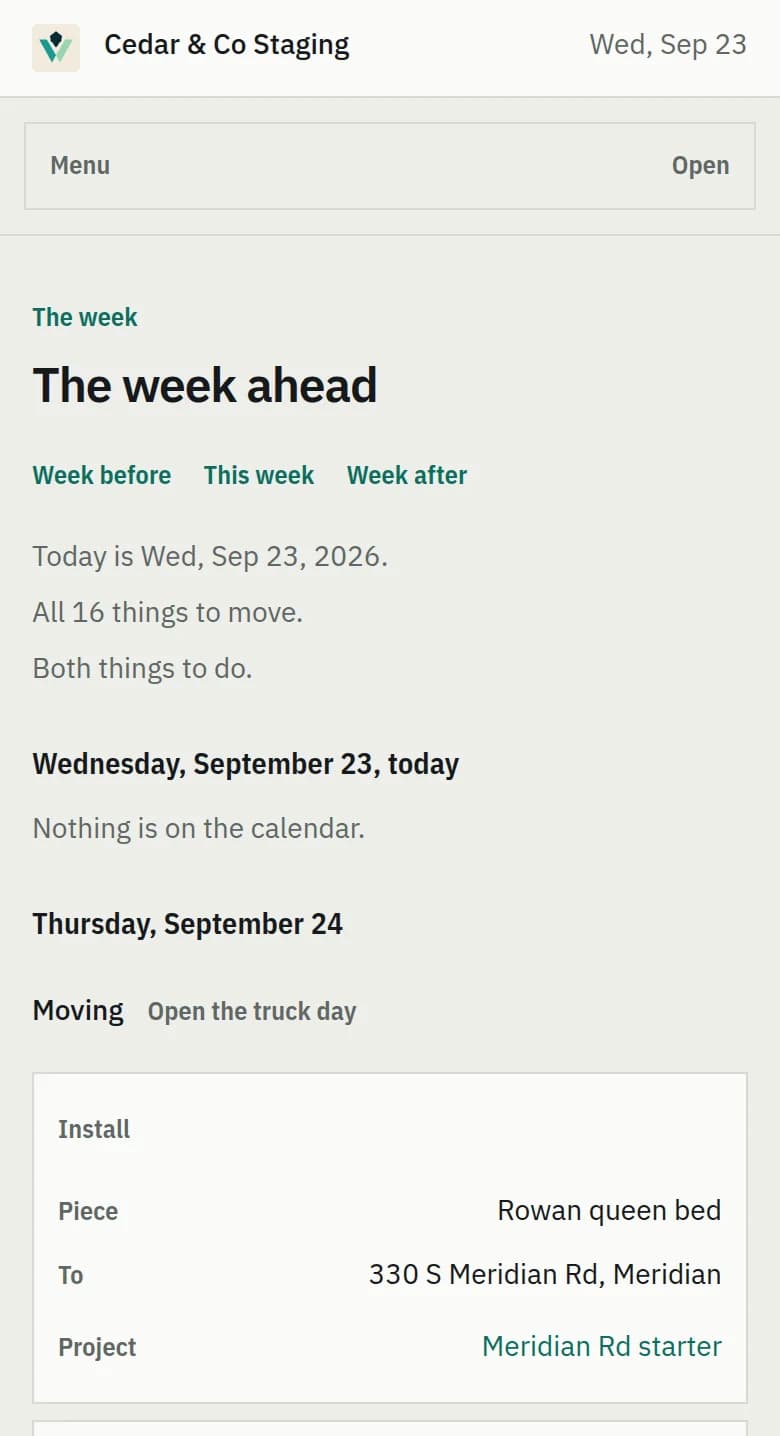
The people using this are in a warehouse, on a truck, or standing in an empty house. So on a phone and on a tablet held upright, a table stops being a table: every row becomes a block and every value keeps its heading, because a number that has lost its label says nothing. Scan boxes do not autocapitalize or autocorrect a sticker number. Nothing is a target you have to aim at.
Every change records who made it. When ChatGPT books a sofa for Jane, the record says ChatGPT booked it for Jane.
What it costs, and where it is
$99 a month, and nothing while the beta is open.
One price. Every user, from the owner to the crew loading the truck. Every piece, whether you track four hundred or forty thousand. Every feature, and the connection your AI works through. Software priced by the seat or by the shelf is charging you for growing. This is not.
That is after the beta. While it is open nobody is billed at all, there is no card to enter, and nobody is charged without being asked first. It is built and deployed and it runs, which is not the same as finished, and we would rather say so here than have you find it out on a Thursday with a truck already loaded.
What beta means
We are still finding the edges. A word that reads wrong in your trade, a screen that takes a step more than it should, a report that answers a question nobody asked. Your records are yours and they come back out whenever you want them, and you would still be running a warehouse on something that is moving under you.
What we want back
Tell us what broke, what was slower than the spreadsheet you left behind, and what your crew could not work out standing in an aisle holding a phone. One staging company saying this part is wrong is worth more to us right now than a subscription.
Two years free
Write to us and we will set your company up as an early adopter: the whole product, at no charge, for two years counted from the day anybody starts being billed. Starting on the beta today does not spend it, and you do not have to write before you sign up. That is our half of the trade.
Getting started
Bring the inventory spreadsheet you already have.
Import takes it as it is. The rows that fail come back together, each with its line number and what was wrong with it, so you fix them in one pass instead of finding them one upload at a time. Your existing labels come in with the rows and keep working from the first scan.
Know what you own. Know where it is. Know where it is going.